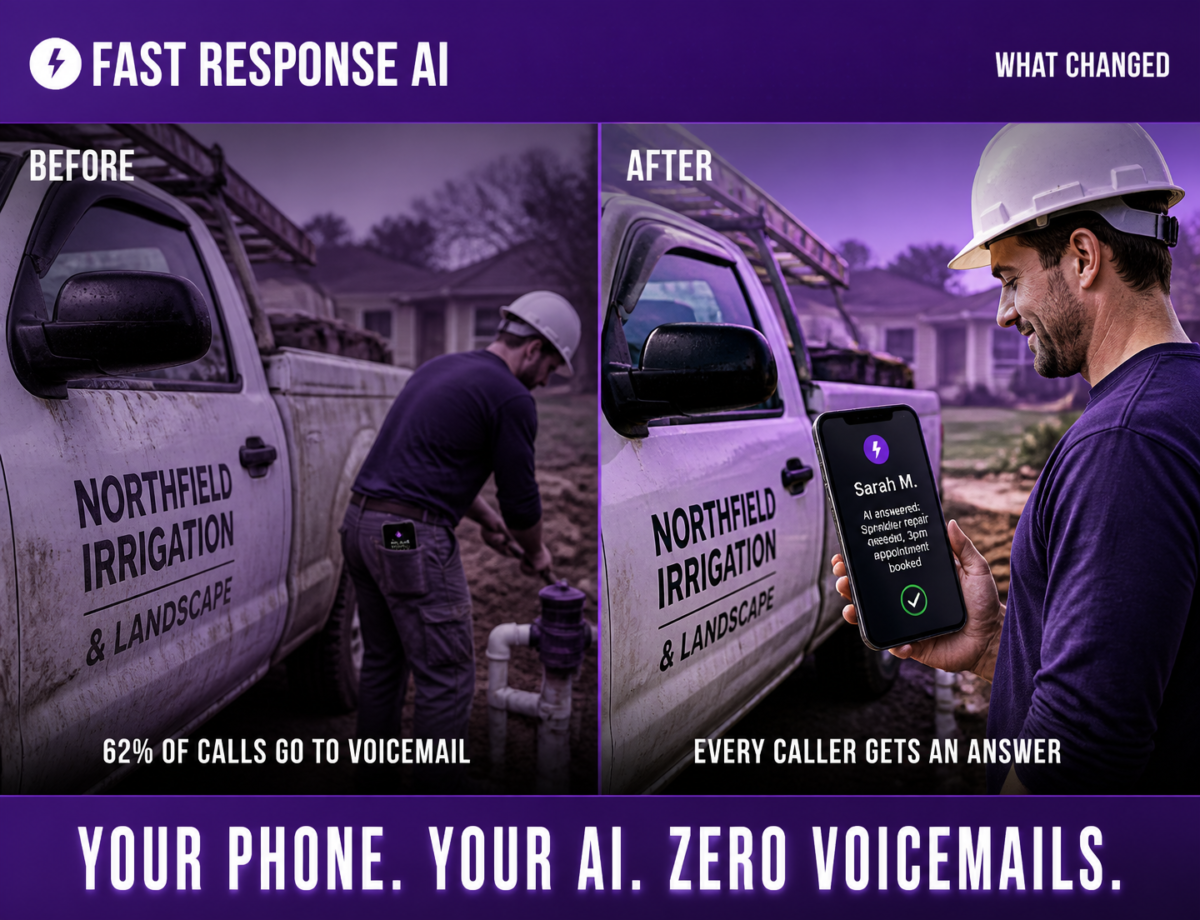
Sixty-two percent of small business owners miss calls while they are on a job. The caller hangs up and dials the next contractor on the list. By the time you check your voicemail, you have already lost the work. That is the problem an AI voice agent solves, and in 2026, the best ones do it in a way most small business owners do not expect. We cover calls in 29 languages for small business owners across the country, and the number-one thing they tell us: the jobs they lose are not lost at the quote. They are lost at the phone.
An AI voice agent is software that answers a phone call, understands what the caller is asking, and responds in natural spoken language without a human picking up. Unlike a traditional answering service that routes your customers through a third-party call center, a modern AI voice agent platform puts you in the conversation: your customers reach your AI when you cannot answer, and every call, text, and chat lands in one inbox you own and control. The AI captures the request and notifies you immediately. You decide what happens next.
The Call You Missed at 3pm Cost You a $600 Job
Every missed call during business hours is a potential $500 to $2,000 job handed to whoever picks up first. For plumbers, HVAC techs, electricians, and landscapers working in the field, missing calls is the cost of actually doing the work. There is no receptionist. There is no office manager answering the phone. There is just a voicemail box that 85% of callers refuse to leave a message on, according to the ClearCall AI Benchmarks Report 2026.
The math is unforgiving. If you run a solo trades business and field 15 inbound calls a week, missing even four of them to voicemail means losing between one and three jobs per week to competitors who happen to answer. That is not a sales problem. That is an availability problem.
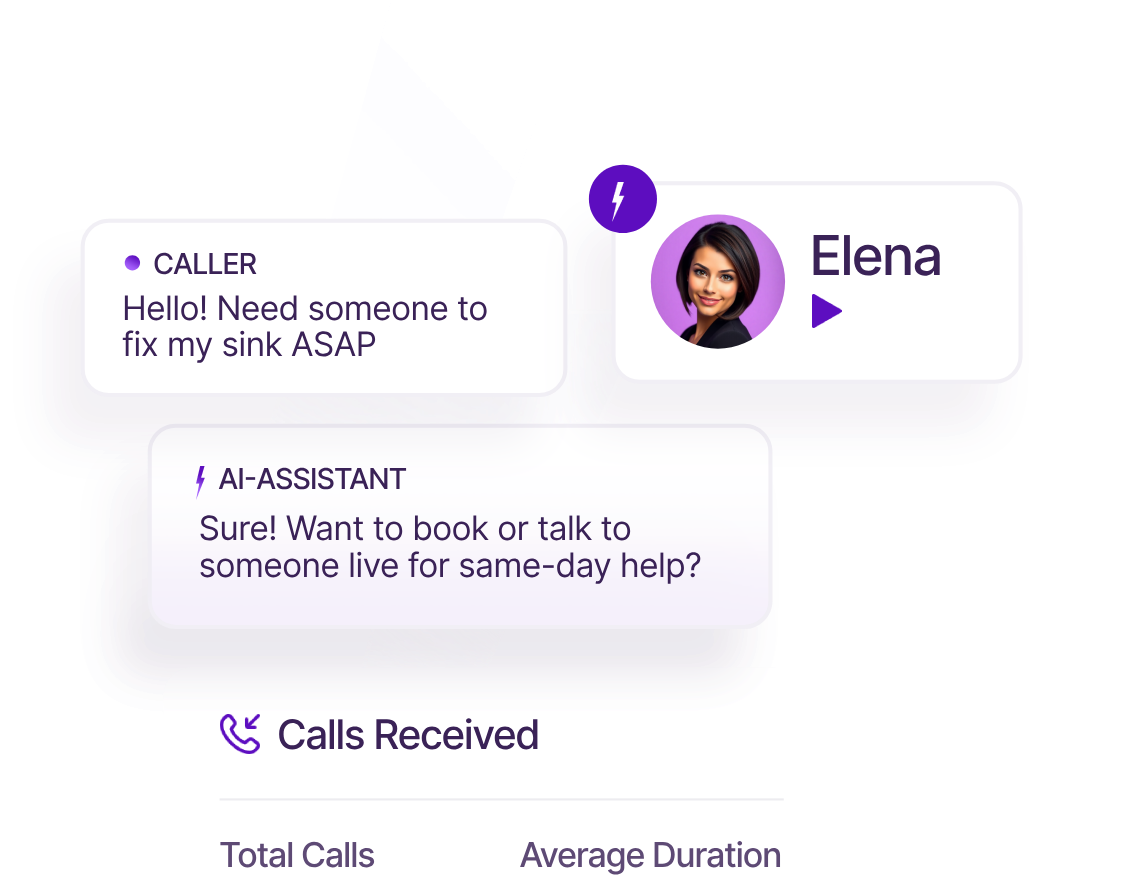
An AI voice agent closes the gap. When you are on a job site and cannot pick up, the AI answers in your name, captures the request, and sends you a full transcript in real time. You see the caller’s name, number, what they need, and whether they want a callback or an appointment. You decide what happens next. The AI does not dispatch anyone. It does not make decisions on your behalf. It handles the inbound, keeps the customer from going to voicemail, and keeps you in the loop.
What Most People Get Wrong About AI Voice Agents
Most articles about AI voice agents describe them as a kind of upgraded call center: a service you pay per call, staffed by AI instead of humans in a warehouse. That framing is wrong, and it leads small business owners toward the wrong buying decision.
Here is what the research actually shows in 2026:
- 85% of callers who do not reach a live answer will not call back. They dial the next result in Google. (ClearCall AI Benchmarks, 2026)
- Small businesses miss an average of 22% of inbound calls during their busiest hours. (ClearCall AI, 2026)
- The AI voice agent market crossed $4.8 billion in 2026, growing at 38% year-over-year.
- AI voice agents now resolve 90 to 95% of routine inbound calls without any human involvement, measured across hundreds of thousands of real business calls.
- Businesses that automate inbound calls report a 3x improvement in response time and 60% fewer appointment no-shows.
- 59% of callers phone a business because they want a quick answer, not to leave a voicemail. (Calilio, 2025)
- Small businesses that implement AI call answering report capturing 30 to 40% more leads in their first month.
The key distinction most buyers miss: an AI voice agent is software running on a platform you own, not a call center you rent. That difference matters enormously for small business owners who value their direct customer relationship.
When a caller reaches your AI, they are reaching YOUR system. The AI speaks in your brand’s voice, answers with your business information, and every transcript goes to your inbox. There is no third party reading your customers’ requests. No agent on someone else’s payroll learning your business. You configure the routing rules. You see every interaction. The customer relationship stays yours.
How a Sprinkler Repair Operator Runs His Business from His Truck
One of the clearest use cases for an AI voice agent is not a 150-unit apartment complex or a multi-location restaurant chain. It is a one-person sprinkler repair business.
He sets up his platform once, in under 10 minutes. He connects his business phone line to a unified inbox. He configures routing rules: calls during business hours ring his cell first. If he does not pick up within three rings, the AI answers. After 6pm, the AI handles everything automatically.
The AI answers with his business name. It asks what the problem is. It captures the caller’s address, the type of system, and whether it is an emergency. It books a diagnostic appointment if the customer wants one. It sends him the full transcript by text while he is finishing a job. He checks it on his phone and calls back the high-priority jobs himself, on his schedule.
He does not miss the call. He does not lose the lead to whoever answers first on Google. And he does not need an office manager or a call center subscription to make it work.
That is how Fast Response AI works: one inbox for call, text, and chat across your business line. You answer when you can. Your AI answers when you cannot. Every interaction is logged in one searchable place, full audit trail across every channel. Setup takes under 10 minutes, no contract, $79 per month base with 100 included AI minutes and 29 languages supported.
For contractors running a lean operation, this is what “never miss a call” actually means in practice.
What to Look for When Evaluating an AI Voice Agent Platform
Not all AI voice agent platforms are built for small business owners. Some are developer tools that require significant technical setup. Some are enterprise systems priced for 100-person teams. Some are answering services with AI added as a feature, where your customer data flows through someone else’s infrastructure.
For a small business owner evaluating options, here is what actually matters:
Ownership of the conversation. Does your customer data stay in your platform, or does it route through a third party? Your customer calls your number. Your AI answers. Your transcript lands in your inbox. Nobody else sees it.
Omnichannel inbox. Calls are only part of how customers reach you. Text messages and web chat inquiries should land in the same inbox as calls, so nothing slips through a channel gap. Look for platforms that unify all three in one place.
Routing you control. You should be able to set rules: ring my cell for the first 20 seconds, then AI takes over; AI handles everything after 6pm; certain caller types go straight to me. Routing logic should be yours to configure.
Speed of setup. If a platform requires a two-week onboarding call with a dedicated account manager, it is not built for a small business. The right tool gets you live in a single session, typically under 10 minutes.
Transparent, predictable pricing. Some platforms charge per call or per minute with no price ceiling. Look for flat monthly pricing with clear overage rates so you can budget accurately as your call volume grows.
Property managers handling after-hours tenant calls have additional considerations: multilingual support for diverse tenant populations, the ability to capture maintenance requests with enough detail to act on them, and a complete audit trail of every conversation across every channel.
Frequently Asked Questions
What is an AI voice agent, exactly?
An AI voice agent is software that handles voice calls using speech recognition and a language model. It listens to what a caller says, understands the request, and responds in natural spoken language. The caller never reaches a voicemail box or a third-party call center. The business owner configures when and how the AI takes over, and every conversation is logged in the owner’s dashboard.
How is an AI voice agent different from a virtual receptionist service?
A virtual receptionist service routes your calls to people who answer on your behalf and relay messages back to you. You are one step removed from the conversation. An AI voice agent platform is software your business owns and operates. Nobody outside your business ever picks up the call. Your customers reach your AI directly, every interaction stays in your platform, and you have complete visibility into every call, text, and chat.
What can an AI voice agent do when a customer calls?
A well-configured AI voice agent answers the call in your business name, understands what the caller is asking, captures contact details and appointment requests, responds to common questions about hours and services, and sends you a real-time transcript. It does not dispatch vendors, contact third parties, or make operational decisions on your behalf. You stay in control of what happens after the AI captures the call.
Does the AI replace my direct relationship with customers?
No. The AI is a safety net for when you cannot answer, not a replacement for direct customer relationships. When you are available, you answer the call yourself through your unified inbox. The AI handles the gaps so your customers are never sent to voicemail. Every caller reaches either you or your AI directly, never an outsourced third party.
How long does it take to set up an AI voice agent?
On platforms designed for small business owners, setup typically takes under 10 minutes. You connect your business phone line, configure routing rules, and add your business information so the AI can answer common questions accurately. No technical expertise is required. Most operators are live on the same day they sign up.
How much does an AI voice agent cost for a small business?
Pricing varies significantly by platform. Some charge per call or per minute with unpredictable costs as volume grows. Flat-rate plans designed for small businesses start around $79 per month and include a set number of AI call minutes, with clear overage rates for additional usage. For most home service operators handling 20 to 50 calls per week, a base plan at that price point covers the majority of their AI call volume.
What languages does an AI voice agent support?
This depends on the platform. The leading small-business platforms in 2026 support between 10 and 29 languages for inbound AI calls. For businesses in multilingual markets, particularly in California and the Southwest, multilingual support is a practical requirement, not a premium feature.
Ready to stop losing jobs to voicemail? Start your free trial at fastresponse.ai. Live in under 10 minutes, no contract.